Investing in real estate may seem out of reach for beginners without large savings but it’s more accessible than ever. Learning how to invest in real estate with no money for beginners can help you build wealth, generate passive income real estate and take advantage of creative strategies like no money down real estate and innovative financing options.
Historically real estate investing required substantial capital, strong credit and years of experience. However modern strategies such as REITs real estate crowdfunding and house hacking allow beginners to enter the market with minimal money. Understanding these methods plus risk management and due diligence is crucial before taking any action.
Imagine turning your first property into a source of steady income while learning the ropes. With wholesaling partnerships in real estate and seller financing you can start small and scale up. Mastering these strategies offers both equity building and financial freedom making real estate a powerful tool for long-term wealth creation.
Quick Table
| Strategy | How It Works | Upfront Cost | Best For | Key Benefit |
| House Hacking | Live in one unit and rent the rest | Low to none (FHA/low-down loans) | Beginners | Reduces housing costs + builds equity |
| Wholesaling | Assign property contracts for a fee | Very low (earnest money) | Active investors | Fast profits without ownership |
| REITs | Buy shares of real estate companies | Very low ($5–$100+) | Passive investors | Earn dividends without owning property |
| Real Estate Crowdfunding | Invest small amounts into large projects | Low ($10–$500) | Beginners & passive investors | Diversification + hands-off |
| Seller Financing | Owner acts as the lender | Low or negotiable | Buyers with low credit | No bank required |
| Lease-to-Own / Lease Options | Rent now buy later with credit applied | Low to moderate | Beginners without savings | Time to save + build eligibility |
| Partnerships in Real Estate | Partner with someone who has capital | Low or none | People with skills but no money | Leverage other people’s money |
| No-Money-Down Loans (FHA/VA) | Government-backed mortgage programs | Low (0%–3.5%) | First-time buyers | Easy entry into property ownership |
| HELOC / Cash-Out Refinance | Use equity from another property | None (borrowed equity) | Existing homeowners | Unlock capital for investing |
Introduction Real Estate Investing for Beginners
Real estate investing refers to the process of purchasing property (physical or financial) to generate income, build equity or both. Traditionally it conjured images of wealthy individuals buying houses or commercial buildings. But those days are long gone.
Thanks to creative strategies like no money down real estate passive investing and community‑driven platforms almost anyone regardless of financial background can start building wealth through real estate.
Understanding No Money Down Real Estate
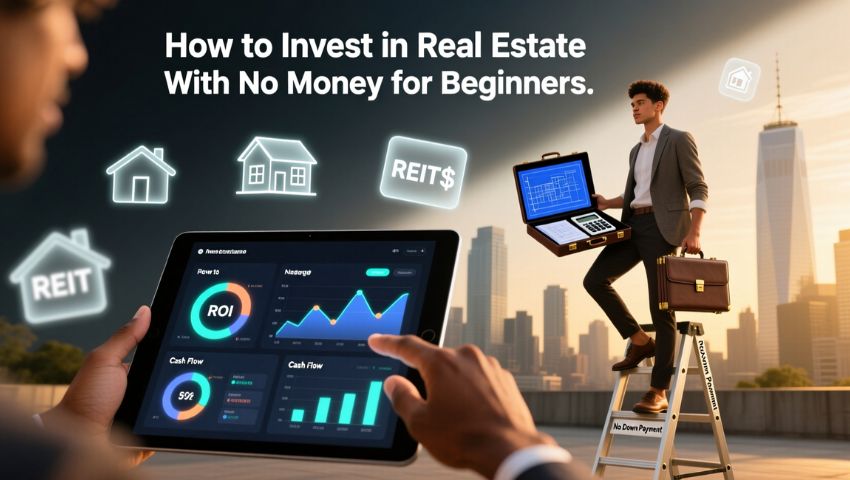
The phrase no money down real estate might sound too good to be true. But in reality it means using strategies that don’t require large sums of your own cash upfront. Instead you leverage creativity negotiation partnerships or other people’s resources.
At its core real estate investing is about value creation not just cash investment. With the right knowledge and tools you can start investing with little to no money down and still see meaningful returns.
Before we dive deeper understand this: education and confidence are your greatest assets.
Anecdote: When Sarah, a schoolteacher, wanted to invest at age 27 she thought she needed tens of thousands of dollars. After studying innovative strategies and joining a local investor network she closed her first property deal with no money down by using seller financing! Today she owns three rental units and earns passive income that covers her own mortgage.
Passive Investing REITs and Real Estate Crowdfunding
Are you someone who wants exposure to real estate without dealing with tenants repairs or property managers? That’s where passive investing comes in.
REITs Real Estate Investment Trusts
A REIT is essentially a company that owns, manages or finances income‑producing properties such as shopping centers, office buildings, apartments and more.
There are two key types:
- Publicly traded REITs bought and sold like regular stocks on exchanges. Examples include Vanguard Real Estate ETF (VNQ) and Schwab U.S. REIT ETF (SCHH).
- Private REITs are not traded on public exchanges and sometimes have higher minimums.
Because REITs are required by law to pay at least 90% of their taxable income as dividends they can be a consistent source of passive income real estate. Tip: Some brokerages allow fractional shares meaning you can begin investing with as little as $1.
Learn more about REITs via this authoritative guide: https://www.investopedia.com/terms/r/reit.asp
Real Estate Crowdfunding Platforms
Real estate crowdfunding lets groups of investors pool their money to purchase larger assets like commercial buildings, multifamily homes or development projects.
Popular platforms include:
- Fundrise starts with as little as $10
- RealtyMogul
- YieldStreet
Keep in mind that some opportunities (especially on YieldStreet) are available only to accredited investors.
Crowdfunding can provide diversification and access to professional property deals without the headaches of property management.
Active Investing Strategies Wholesaling House Hacking and Partnerships in Real Estate
If you’re ready to get your hands a little dirty, active investing is where you take direct action to create investment results. It often takes time and effort even if it doesn’t require a big bank account.
Wholesaling Quick Entry With Minimal Cash

Wholesaling is one of the most popular beginner real estate strategies because it typically requires little capital upfront.
How it works:
- Find an undervalued property.
- Get it under contract using a small earnest money deposit.
- Assign that contract to another buyer for a fee.
What makes wholesaling attractive:
- You never actually buy the property.
- Your cash risk is minimal.
- Success relies on strong deal analysis and a solid investor network.
Wholesaling basics: https://www.investopedia.com/terms/w/wholesalingrealestate.asp
Important: Always follow your local real estate laws. Never use misleading tactics to convince sellers.
House Hacking Live for Free (or Close to It)
House hacking is a powerful concept especially for beginners.
It simply means living in a property while renting out other parts to cover the mortgage.
Examples:
- Buy a multifamily property (duplex/triplex) and rent out the extra units.
- Convert a basement or garage into an accessory dwelling unit (ADU).
- Rent out rooms on Airbnb or VRBO.
Pro tip: Using an FHA loan or VA loan can dramatically reduce the down payment sometimes to as low as 3.5%.
Explanation of FHA loans: https://www.hud.gov/program_offices/housing/fhahistory
Partnerships in Real Estate
Not all wealth comes from individual effort, sometimes it comes from strategic partnerships.
If you lack funds but have skills like deal analysis negotiation prowess or property management experience you can team up with someone who has capital but little time.
Benefits:
- Access to Other People’s Money (OPM)
- Shared responsibility
- Increased deal capacity
Anecdote: Two friends, one a construction expert the other with capital formed a partnership. Within two years they acquired five rental units using OPM and now split profits equally.
Creative Financing Options Seller Financing and Lease Options
When traditional bank loans are out of reach, creative contracts can open doors.
Seller Financing (No Bank Needed)
Instead of borrowing from a bank you pay the property owner directly over time.
Why this matters:
- Possible low‑down‑payment or even no down payment
- Flexible terms negotiated between buyer and seller
- Builds equity ownership quickly
Seller financing overview: https://www.investopedia.com/terms/s/seller-financing.asp
Lease Options (Rent‑to‑Own)
With a lease option (also called rent‑to‑own) you rent a property with the option to buy it later at a set price.
Benefits:
- Lower upfront cash compared to traditional down payments
- Sometimes a portion of rent is credited toward purchase price
- The right to decide later
More on lease options: https://www.investopedia.com/terms/l/lease-option.asp
Make sure contracts clarify details like purchase price timeline and fees.
Advanced Tactics HELOC Real Estate Investing and Flipping Houses
As you grow more comfortable you can explore higher‑impact strategies.
HELOC Real Estate Investing
A Home Equity Line of Credit (HELOC) lets you borrow against the value of a home you already own.
Ways to use it:
- As a down payment on an investment property
- To buy tools or materials for renovations
- To add rental spaces (like ADUs)
Learn about HELOCs: https://www.investopedia.com/terms/h/heloc.asp
HELOCs use your home as collateral so always plan ahead and understand risks!
Flipping Houses
Taking a property, renovating it and selling it for profit is called flipping houses.
You may use:
- Hard money loans
- HELOC
- Bank financing
Success comes from:
- Buying low (often distressed homes)
- Smart renovations
- Strong market timing
House flipping guide: https://www.investopedia.com/articles/mortgages-real-estate/08/house-flipping.asp
Passive Income Real Estate Rental Income and Property Management
Many investors aim for passive income real estate, a scenario where rental revenue pays the bills (and then some).
Rental Income
Rental income is the money tenants pay you for living in your property.
Key aspects:
- Stabilizes cash flow
- Builds equity over time
- Can be reinvested in additional properties
Net income is rent minus:
- Mortgage
- Real estate taxes
- Maintenance
- Property management
Property Management
Good property management is essential if you don’t want to handle repairs or tenant issues yourself.
Options:
- Self‑management (lowest cost highest effort)
- Professional property managers (costs 8–12% of rent)
More about property management: https://www.investopedia.com/terms/p/property-management.asp
Beginner Real Estate Strategies and Low‑Cost Real Estate Investing
Here’s where we bring it all together into a starting roadmap.
Start With Real Estate Education
Before spending a single dollar:
- Read books
- Join local investment meetups
- Take online courses
Investing without education is like driving at night with no headlights.
Real estate education basics: https://www.zinvestopedia.com/terms/r/realestateinvesting.asp
Build Your Investor Network
Success in real estate = who you know.
Your network can provide:
- Leads
- Capital access
- Mentorship
- Joint venture opportunities
Perform Due Diligence and Deal Analysis
Always ask:
- What’s the true value of this property?
- What are repair costs?
- Is the market growing?
Due diligence is the difference between profit and loss.
Conclusion
Real estate offers beginners a unique opportunity to build wealth even with little or no money. By leveraging strategies like no money down real estate house hacking REITs and real estate crowdfunding you can start generating passive income real estate while minimizing risk. Educating yourself and performing thorough deal analysis ensures smarter, more confident investments.
Taking action today can set you on the path to long-term financial freedom. Using partnerships in real estate seller financing and lease-to-own options allows beginners to scale without large upfront capital. With dedication due diligence and a solid investor network even first-time investors can enjoy equity building rental income and sustainable growth in the real estate market.

Hi, I’m Finn Clune , the admin and founder of Hub Finance Spot. I created this platform to make finance, business, and investment topics easier to understand for everyone. Over the years, I’ve gained experience in personal finance, business development, and market analysis. My goal is to share practical and reliable information that helps readers make informed financial decisions. At Hub Finance Spot, I focus on creating content that’s simple, clear, and based on real insights so you can trust what you read.